Version 1
GET /api/v1/emojis
Retrieve the list of custom emojis used in nonsense entries. This is meant to be used as a reference. 
GET /api/v1/variables
Retrieve the list of variables used in nonsense entries.
GET /api/v1/news
Retrieve the news from Nontrinsic. Alternatively, you can get the news as an RSS feed.
GET /api/v1/nonsense
Retrieve the nonsense database as a CSV1, JSON, or TXT2 file. Append ?format=csv, ?format=json, or ?format=txt at the end to get either format.
An entry that contains variables will be replaced by the server, except for $AUTHOR$, $SERVER$, $CHANNEL$, and ${app_name}. Refer to the Entry Formatting page for those variable definitions to be implemented on the client.
If an entry contains variables, there will be original_nonsense inside the JSON response that includes the raw entry text without the server replacing the variables. This is useful as a reference.
You may append these parameters at the end of the URL:
q=query— Restrict entries in the database export matching a search term.format=format— Export the database as acsv1,json, ortxt2 file.after=timestamp— Only export entries after a specified Unix timestamp.before=timestamp— Only export entries before a specified Unix timestamp.
Examples:
- Export the nonsense database containing the word “entry”:
/api/v1/nonsense?q=entry - Export the nonsense database as a plain text file:
/api/v1/nonsense?format=txt - Export the nonsense database as a JSON file that contains the word “red” since 1609718400 up until 1643032654:
/api/v1/nonsense?format=json&q=red&after=1609718400&before=1643032654
GET /api/v1/nonsense/random
Retrieve a random nonsense entry as JSON. You can optionally append ?format=html at the end to have the nonsense Markdown parsed as HTML by the server first, useful when the client cannot use a Markdown parser but can display HTML.
An entry that contains variables will be replaced by the server, except for $AUTHOR$, $SERVER$, $CHANNEL$, and ${app_name}. Refer to the Entry Formatting page for those variable definitions to be implemented in the client.
If an entry contains variables, there will be original_nonsense inside the JSON response that includes the raw entry text without the server replacing the variables. This is useful as a reference.
GET /api/v1/nonsense/:uuid
Retrieve a specific nonsense entry as JSON by its UUID. You can optionally append ?format=html at the end to have the nonsense Markdown parsed as HTML by the server first, useful when the client cannot use a Markdown parser but can display HTML.
GET /api/v1/nonsense/:uuid.png
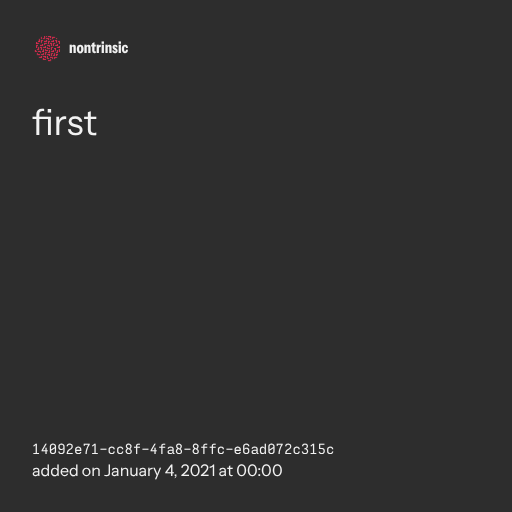
Retrieve a share image of a specific nonsense entry by its UUID. Note that PNG is the only supported format for now. To get a wider image, append ?format=wide at the end. To get a print-optimized version of the image, append ?theme=light at the end.
GET /api/v1/nonsense/status
Retrieve the status of the nonsense database. This is useful when the client is caching the database for offline use. In that case, the client can compare the cache with the online database based on the timestamp of the latest entry.
POST /api/v1/nonsense/report
Report a nonsense entry by its UUID with a valid reason:
| Value | Description |
|---|---|
hate_speech |
Slurs or hate speech |
sexual_content |
Explicit sexual content |
graphic_violence |
Graphic violence |
personal_information |
Private or personally identifiable information |
duplicate |
Same or near-identical entry already exists |
other |
Other violation (use details to elaborate) |
…along with optional details text.
POST to the reporting endpoint with the following JSON structure:
{
  "entryUuid": "00000000-0000-0000-0000-000000000000",
  "reason": "other",
  "details": "Optional additional context"
}
Replace entryUuid, reason, and details with actual reporting data. entryUuid must be an existing UUID of a nonsense entry.
GET /api/v1/nonsense/galaxy
Retrieve the nonsense galaxy as a CSV1 or JSON file; this is updated every 24 hours on an external server. Append ?format=csv or ?format=json at the end to get either format.
Note that the nonsense column may contain character encoding quirks; if you want to display the galaxy along with the entries (see an example), be sure to cross-reference the entry UUIDs with entries in the nonsense database to avoid such issue.
To learn more on how the nonsense galaxy is generated, see https://codeberg.org/nontrinsic/galaxy.
GET /api/v1/nonsense/galaxy/status
Retrieve the status of the nonsense galaxy. In rare cases, if the galaxy hasn’t been generated yet by the external server, it will return an error with the 502/503 HTTP code.
EXPERIMENTAL: OData backend
This is experimental and may be removed in the future.
The (minimal) OData endpoints only exist to be used in data visualization software such as Tableau, like this dashboard for example.
/odata/v2/$metadata
Retrieve the metadata about the columns that are in the database with each of their own types.
/odata/v2/nonsense_list
Retrieve the database as Atom via OData v2. You can append ?all=true at the end of the URL to retrieve the full database.
Who’s using Nontrinsic?
- The original founder of the nonsense database, Azka (aka Arti), uses an export of the nonsense database from Nontrinsic in her website’s nonsense ticker: https://artifyber.xyz/e/nansenz
- Bricked has made a nonsense generator from the nonsense database using Markov chains: https://codeberg.org/bricked/nonsense-generator
- Maxie, using the API with the Python wrapper for Nontrinsic:
- …has developed these new versions of NonsenseBot:
- Discord: https://codeberg.org/nontrinsic/discord
- Fediverse: https://codeberg.org/nontrinsic/fedi
- swagsocial: https://codeberg.org/nontrinsic/swagsocial
- …and has developed a CLI tool for Nontrinsic to get nonsense in the terminal: https://codeberg.org/nontrinsic/cli
- …has developed these new versions of NonsenseBot:
- jb has integrated Nontrinsic as a random quotes provider for a soft fork of Wafrn used on neo.tokyonight.city: https://codeberg.org/tokyonightcity/wafrn
- kuraga has trained NonsenseGPT (forked from nanoGPT) on entries from Nontrinsic: https://github.com/kuraga0/NonsenseGPT
- Inventionpro has made a simple nonsense galaxy viewer using the API: https://github.com/inventionpro/galaxy-viewer
- Apart from the web app and the mobile apps (plus the desktop app on macOS)…
- Linerly has made a native app inside Azka’s new website (or in this case, a web-based operating system), OmniOS, with some refinements from Azka herself: https://azkazavian.me/ (click on “Nontrinsic” to open the app!)
Footnotes
-
The default format for the export if the format is not explicitly included. ↩ ↩2 ↩3
-
Only single-line nonsense entries will be included in the plain text file (TXT) export. Note that even though TXT means plain text, it’s actually Markdown! You should parse the Markdown if possible to make sure the entries have proper formatting. ↩ ↩2